A gallstone found on a scan does not automatically mean you need an operation, while pain, infection, jaundice or a bile-duct stone can require prompt treatment. By weighing your symptoms, test results, medical risks and the available procedures, you can identify which treatment pathway deserves discussion with a surgeon.
Key takeaways
- Silent gallstones usually need observation, not preventive surgery.
- Ultrasound and liver-function tests help identify the safest treatment pathway.
- ERCP removes bile-duct stones; gallbladder removal prevents recurring gallbladder attacks.
- Ask which laparoscopic approach fits your anatomy, symptoms and surgical findings.
Do your gallstones need treatment now?
Incidentally discovered gallstones that cause no symptoms usually need observation, not preventive surgery. A doctor may recommend treatment for selected high-risk gallbladder abnormalities or particular surgical circumstances, but the stone count alone does not decide the need for an operation.
Repeated right-upper-abdominal pain, especially after meals, suggests biliary colic and needs medical assessment. Seek prompt care if you have:
- Fever or chills with abdominal pain
- Yellow eyes or skin, dark urine, or pale stools
- Persistent vomiting or worsening tenderness
- Pain that continues for several hours instead of easing
- Severe continuous pain, confusion, or inability to keep fluids down
- Severe upper-abdominal pain spreading to the back, which can indicate pancreatitis
These symptoms can reflect acute cholecystitis, a blocked common bile duct, infection, or pancreatitis. Go to an emergency department for severe continuous pain, confusion, dehydration from vomiting, fainting, or rapidly worsening jaundice.
Gallbladder removal is the usual definitive treatment for recurrent symptomatic stones, but it does not guarantee that every abdominal symptom will disappear. Reflux, peptic disease, irritable bowel syndrome, pancreatitis, fatty-food intolerance, or another abdominal condition can cause similar pain.
A gallstone treatment consultation in Mumbai should therefore match the diagnosis to the proposed operation before surgery is chosen.
How ultrasound and blood tests change the treatment pathway
The ultrasound pathway depends on anatomy and inflammation, not the number or size of stones alone. Review the report and images for gallbladder-wall thickening, fluid around the gallbladder, an impacted stone at the neck, and common-bile-duct dilation.
| Finding | What it may suggest | Likely next step |
|---|---|---|
| Wall thickening or fluid around the gallbladder | Acute inflammation, especially with continuous pain or fever | Prompt surgical assessment and treatment planning |
| Impacted stone at the neck | Blocked gallbladder drainage and possible cholecystitis | Match the scan with symptoms, examination and blood tests |
| Dilated common bile duct | Possible duct stone or obstruction | Liver tests followed by MRCP or endoscopic ultrasound when indicated |
| No duct dilation or visible duct stone | Lower suspicion, but not a complete exclusion | Consider symptoms and blood-test results before closing the investigation |
A complete blood count helps identify infection through a raised white-cell count. Bilirubin, ALT, AST, alkaline phosphatase and, when useful, gamma-glutamyl transferase show whether bile flow or liver cells are affected; abnormal results with jaundice, dark urine or pale stools increase concern for obstruction.
A normal ultrasound does not fully exclude a common-bile-duct stone. Abnormal liver tests, duct enlargement, jaundice, or pancreatitis risk can lead to magnetic resonance cholangiopancreatography (MRCP) or endoscopic ultrasound. ERCP is reserved for cases where duct treatment is likely because it can cause pancreatitis, bleeding and infection.
Observation, ERCP or gallbladder removal: which treatment fits?
Observation fits most people whose gallstones were found incidentally and cause no symptoms. Avoiding large, fatty meals can reduce attacks, but diet does not dissolve stones or prevent every future episode. Medication has a limited role and is not the usual definitive treatment for a fit adult with recurrent biliary pain.
| Option | What it does | When it fits |
|---|---|---|
| Observation and symptom-focused diet | Monitors stones and limits foods that trigger pain | Asymptomatic stones or patients awaiting assessment |
| Medication | Attempts stone dissolution in selected circumstances | Limited cases; not the usual solution for recurrent symptoms |
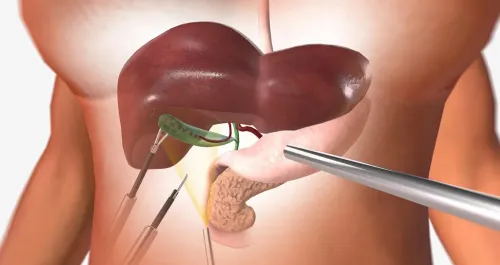
| Laparoscopic cholecystectomy | Removes the entire gallbladder through small abdominal incisions | Recurrent biliary colic or other symptomatic gallstones |
| ERCP | Removes a stone lodged in the common bile duct | Choledocholithiasis, jaundice or duct obstruction; often followed by surgery |
Simply extracting gallbladder stones leaves the stone-forming organ behind, so recurrence remains a problem. For symptomatic stones, laparoscopic cholecystectomy is usually the definitive treatment; it stops gallstone attacks but will not cure pain caused by reflux, peptic disease, irritable bowel syndrome or another condition.
Acute calculous cholecystitis in a patient fit for anaesthesia usually calls for early surgery rather than waiting for another attack. If a duct stone is present, ERCP clears the duct, followed by laparoscopic gallbladder removal during the same treatment episode when medically suitable.
A consultation for gallbladder stone surgery in Mumbai should match the procedure to the ultrasound, liver tests, symptoms and anaesthetic risk.
Comparing laparoscopic options and the situations that change the plan
Fewer incisions do not automatically make one operation safer or more effective. The best gallbladder stone surgery option in Mumbai depends on your symptoms, duct findings, inflammation, previous operations and anaesthetic risk—not on the device name.
| Option | What it involves | Main trade-off |
|---|---|---|
| Multi-port laparoscopy | Camera and instruments through several small cuts | Established access, with more than one incision |
| Single-incision or reduced-port laparoscopy | Fewer abdominal entry points | Smaller access footprint, but difficult anatomy can limit its advantage |
| Robotic assistance | Surgeon controls articulated instruments from a console | Greater instrument control in selected cases, without guaranteeing better recovery |
“Laser gallbladder surgery” needs a precise explanation. Laser treatment can describe niche stone fragmentation, often inside the common bile duct; routine gallbladder removal generally uses a camera, instruments and energy devices, not a laser.
Before dividing the cystic duct and artery, the surgeon must obtain the critical view of safety: clear the hepatocystic triangle, identify only two structures entering the gallbladder and separate its lower portion from the liver.
Work through these plan-changing factors:
- Suspected duct stones may require MRCP, endoscopic ultrasound or ERCP before or around surgery.
- Severe inflammation or dense adhesions after upper-abdominal surgery can make open surgery safer.
- Bleeding risk, cirrhosis or serious anaesthesia risk may change timing or approach.
- Pregnancy requires anaesthesia and timing planning with the obstetric team.
- If anatomy is unclear, bleeding occurs, or cancer or bile-duct injury is suspected, conversion to open surgery is a safety decision—not necessarily a failure.
What to check during a gallstone surgery consultation in Mumbai
Take the ultrasound images and written report to the appointment. A gallstone treatment consultation in Mumbai should include a physical examination, blood tests such as a complete blood count and liver-function tests, and review of your symptoms, medicines and allergies. Expect fasting instructions and an anaesthesia assessment before scheduling surgery.
Use this checklist:
- Ask whether a stone has entered the common bile duct.
- Ask whether MRCP, endoscopic ultrasound or ERCP is needed. ERCP is usually reserved for likely duct treatment because it can cause pancreatitis, bleeding or infection.
- Ask which laparoscopic technique is proposed and what “laser” means if that term is used.
- Ask what would trigger conversion to open surgery: unclear anatomy, bleeding, dense adhesions, severe inflammation, suspected injury or cancer.
- Ask what follow-up includes and when you can resume food, work and exercise.
Tell the team about blood thinners, diabetes medicines, possible pregnancy, previous operations, obesity, cirrhosis and any difficult anaesthetic history.
| Investigation | Main purpose | What it changes |
|---|---|---|
| MRCP | Maps the bile ducts without endoscopy | Clarifies suspected duct stones |
| Endoscopic ultrasound | Detects small duct stones | Helps avoid unnecessary ERCP |
| ERCP | Removes an accessible duct stone | Treats the duct but carries procedure risks |
Discuss short-term loose stools or bloating, plus uncommon bleeding, infection, bile leak and bile-duct injury. Dr.VinayKumar Thati-Laser & Laparoscopic Surgeon is one local option for reviewing these findings and trade-offs.
Related service
LAPAROSCOPIC SURGERY What are gallstones? Gallstones form when bile stored in the gallbladder hardens into stone-like material. View service → |
Frequently asked questions
Do gallstones always need surgery?
No. Incidentally discovered gallstones that cause no symptoms usually need observation rather than preventive surgery. Treatment depends on symptoms, complications, gallbladder abnormalities and surgical circumstances.
How do ultrasound and blood tests affect gallstone treatment?
Ultrasound shows stones, gallbladder inflammation, wall changes and bile-duct dilation. Blood tests, including liver-function tests, help identify bile-duct obstruction or infection and determine whether further treatment is needed.
When is ERCP used instead of gallbladder removal?
ERCP is used to find and remove stones lodged in the common bile duct. It does not remove the gallbladder, so your surgeon may discuss gallbladder removal separately when recurrent gallstone problems are likely.
What are the main laparoscopic gallbladder surgery options?
The standard approach is laparoscopic cholecystectomy, which removes the gallbladder through small incisions. The surgical plan can change because of inflammation, scar tissue, bleeding, anatomy or findings during the operation.
What should you ask during a gallstone surgery consultation in Mumbai?
Ask what your ultrasound and blood results show, whether observation is safe, whether you need ERCP, which operation is proposed, what could convert it to open surgery and how recovery will be managed.
Keywords