The time from your first call to stapled haemorrhoidopexy depends on diagnosis, surgeon and operating-room availability, medical clearance, and whether your symptoms need urgent attention. You will be able to distinguish a consultation date from a confirmed surgery date, prepare the right records and questions, and recognise when waiting for a routine appointment is unsafe.
Key takeaways
- Separate the consultation date, preoperative clearance and operation date.
- Ask whether your symptoms and haemorrhoid grade suit stapled haemorrhoidopexy.
- Carry previous reports and a complete medicine list to your appointment.
- Seek urgent assessment for heavy bleeding, faintness, severe pain or fever.
How quickly can consultation and stapler surgery be scheduled?
Three dates are easily confused: your first specialist consultation, completion of preoperative checks, and the operation itself. A consultation confirms the diagnosis and discusses treatment; it does not automatically reserve a theatre.
Same-day surgery after the first consultation is uncommon but possible for a carefully selected patient. You need a confirmed diagnosis, an available operating-room slot, completed blood tests, anaesthesia clearance, no medication concerns and suitable fasting arrangements.
A clinic offering same-day consultation does not guarantee same-day surgery. The operation can still be deferred if preparation is incomplete or the facility has no theatre opening.
In Mumbai, timing depends on:
- The surgeon’s availability and the hospital or day-care theatre schedule
- Blood tests and anaesthesia review
- Medication changes, including plans for blood thinners
- Uncontrolled diabetes or another medical condition
- Anaemia, severe constipation or an active infection
- Whether the case is elective or urgent
For a practical estimate, ask for the earliest consultation, the earliest provisional operating date and the conditions that could move it. Someone searching for piles stapler surgery near me in Mumbai should ask the same questions before booking.
When arranging a piles surgery appointment in Mumbai, request the expected interval for each of the three dates. There is no dependable city-wide waiting-time promise; confirmed diagnosis and safe preparation determine the quickest suitable route.
How does the surgeon decide whether stapled haemorrhoidopexy is suitable?
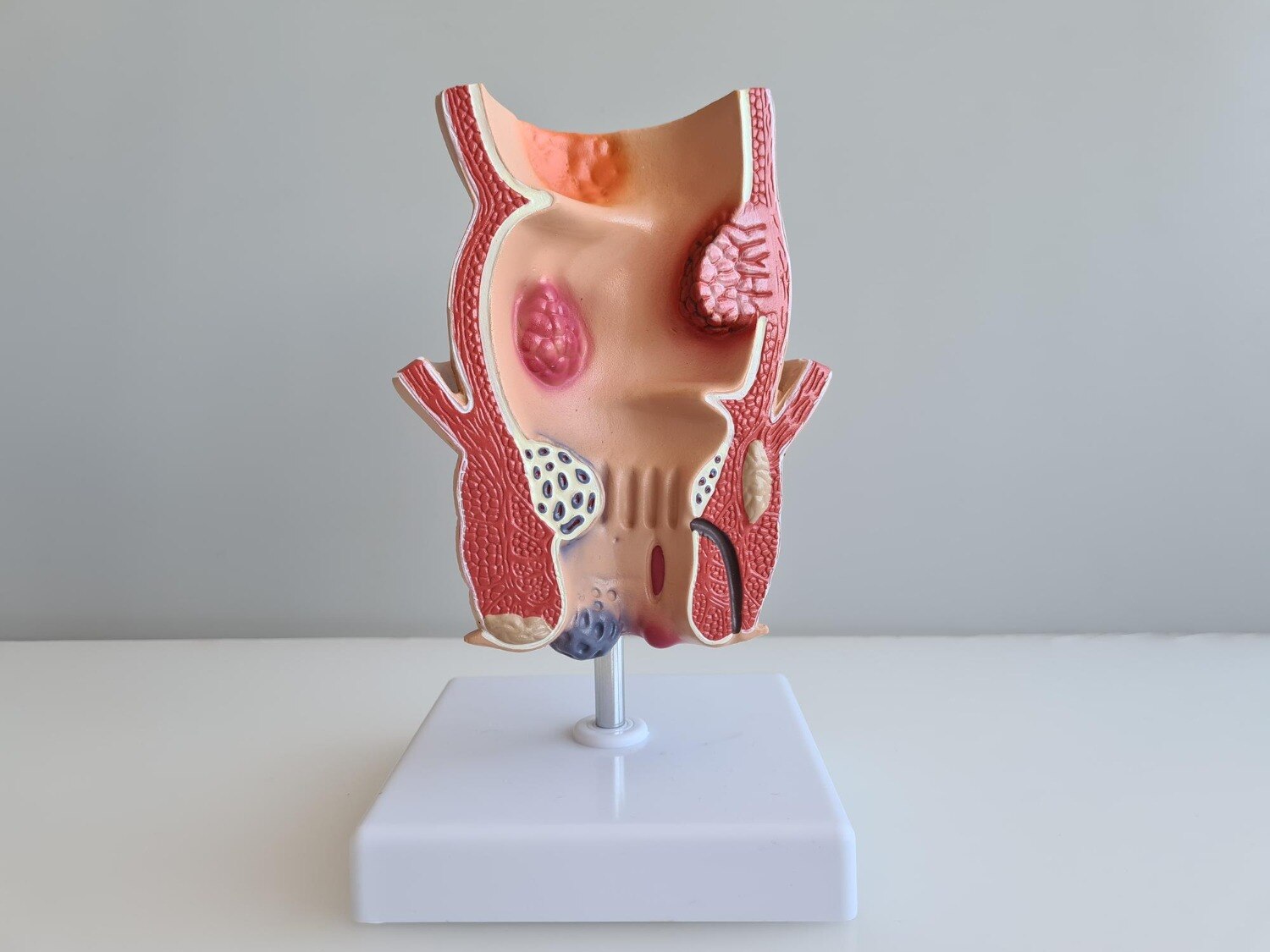
“Piles stapler surgery” usually means stapled haemorrhoidopexy. A circular stapler removes a ring of rectal mucosa above the haemorrhoids and lifts prolapsing internal tissue. It does not cut away an external lump and is not a laser procedure.
The surgeon takes a history of bleeding, pain, prolapse, bowel habits and previous treatment, then inspects the anus, performs a digital rectal examination and uses anoscopy or proctoscopy. These steps identify the bleeding source and assess internal prolapse, grade, external components and recurrent disease.
Do not automatically blame bleeding on piles: fissure, fistula, abscess, colorectal polyps, inflammatory bowel disease, rectal prolapse and cancer need different investigations or treatment.
| Finding | What it means | Usual decision |
|---|---|---|
| Prolapsing internal haemorrhoids, often grade III or selected grade IV | Stapled repair may address the internal prolapse | Consider stapled haemorrhoidopexy |
| Predominantly external or thrombosed lump | The stapler does not remove that external problem | Consider another treatment |
| Acute infection or unexplained bleeding | Piles may not be the cause | Treat or investigate the cause first |
| Prolapse unsuitable for stapling | Another operation or nonoperative care may work better | Do not book on symptoms alone |
If you search for a piles specialist near me, ask which exact procedure is proposed and why it fits your prolapse pattern. A recurrent case also needs review before choosing stapled haemorrhoidopexy.
What should you do when booking a piles surgery appointment in Mumbai?
A piles surgery appointment in Mumbai should begin with a clinical assessment, not a direct stapler booking. Contact the clinic, describe bleeding, pain and prolapse, and share previous reports. Attend the examination; after diagnosis, confirm the hospital or operating-room date.
Bring:
- Colonoscopy or proctoscopy reports, scans and previous treatment details.
- A complete medicine and supplement list, allergies, medical conditions, bowel-habit changes, and the duration, amount and pattern of bleeding.
Ask these questions before accepting a date:
| Question | Why it matters |
|---|---|
| Which exact procedure is proposed? | Confirms stapled haemorrhoidopexy rather than laser or another operation. |
| What anaesthesia will be used? | Identifies the required assessment and fasting instructions. |
| Which hospital or day-care facility will host it? | Confirms theatre, anaesthesia and emergency support. |
| What are the total fees and inclusions? | Prevents unexpected hospital, anaesthesia or follow-up charges. |
| Which blood tests and medical clearances are required? | Shows what must be completed before scheduling. |
| Should you fast, adjust medicines, arrange an adult escort or reserve overnight observation? | Prevents delays and unsafe discharge planning. |
Never stop aspirin, clopidogrel, warfarin or a direct oral anticoagulant without the prescribing clinician’s plan. A practice such as Dr.VinayKumar Thati-Laser & Laparoscopic Surgeon can be a local contact; verify the surgeon, facility, anaesthesia support and emergency arrangements, not proximity alone.
Related service
STAPLER SURGERY Surgical staplers for internal use are used to deliver staples to tissues inside the body during surgery for: Removing part of an organ (resection)... View service → |
How does stapler surgery compare with other piles treatments?
A fast booking is not a reason to choose the wrong operation. “Piles stapler surgery” usually means stapled haemorrhoidopexy: a circular stapler removes a ring of rectal mucosa above the haemorrhoids and lifts prolapsing internal tissue. It does not remove a large external lump.
| Option | Problem treated | Pain, wound care and recovery | Recurrence and trade-offs |
|---|---|---|---|
| Rubber-band ligation | Selected smaller internal haemorrhoids | Usually avoids an operation, with little external wound care and quick activity recovery | Repeat sessions may be needed; it does not correct a large external component |
| Conventional excisional haemorrhoidectomy | Substantial haemorrhoidal tissue or mixed internal and external disease | Removes tissue but usually causes more early pain and wound care | More definitive for bulky disease, but recovery is harder |
| Doppler-guided haemorrhoidal artery ligation | Selected internal prolapse by reducing arterial inflow | Usually limited external wound care and early discomfort | Recurrence and suitability depend on the prolapse pattern |
| Stapled haemorrhoidopexy | Selected prolapsing internal haemorrhoids, not an external thrombosed lump | Often less early pain and external wound care than excision, allowing faster early recovery | Recurrent prolapse or symptoms and later reintervention are important trade-offs |
Laser treatment and stapled haemorrhoidopexy are different procedures, not interchangeable names. If searching for a stapler surgery surgeon in Mumbai, ask which exact technique is proposed and why it matches your prolapse pattern.
Which piles symptoms need urgent assessment instead of a routine appointment?
Heavy or persistent rectal bleeding, black stools, dizziness or fainting require emergency assessment, not a routine search for a piles specialist near me. Contact emergency services or attend an appropriate hospital service when bleeding continues, weakness or fainting occurs, or symptoms are severe.
Seek urgent medical assessment for:
- Fever, severe or rapidly increasing anal pain, rapidly worsening swelling, or a tender lump that cannot be pushed back.
- Inability to pass urine.
These signs can indicate significant blood loss, infection, thrombosis, urinary retention, or a diagnosis other than uncomplicated haemorrhoids. Do not wait for an elective stapler slot. A painful lump is not automatically suitable for stapled haemorrhoidopexy.
| Symptom pattern | Action |
|---|---|
| Severe, ongoing, or faintness-associated symptoms | Emergency services or hospital assessment now |
| Worsening pain, swelling, fever, or urinary difficulty | Same-day urgent assessment |
| Mild, unchanged symptoms | Routine consultation or request an earlier appointment |
What should you arrange for the operation and the first week afterward?
Reserve enough time for admission, anaesthesia, recovery and discharge; “day-care” or “short-stay” means an intended brief admission, not guaranteed same-day discharge. Arrange an adult escort, and do not drive until the clinical team permits it.
Discharge requires stable vital signs, controlled pain, the ability to pass urine and no significant bleeding. Overnight observation is necessary if recovery is slow or concerns arise.
During the first week, follow the prescribed pain-medicine schedule, drink fluids and use the recommended fibre, stool softener or laxative plan. Avoid straining. Some rectal discomfort or light bleeding can be expected if your surgeon has explained it.
- Seek urgent help for heavy bleeding, fever, worsening pain or difficulty passing urine.
- Ask when you can return to work, exercise and driving.
- Confirm the first follow-up date and the after-hours contact number.
- Ask what happens if bleeding or prolapse continues.
The quickest safe route is confirmed diagnosis, appropriate preparation and a facility with anaesthesia and postoperative emergency support.
Frequently asked questions
How quickly can consultation and stapler surgery be scheduled?
The consultation, preoperative checks and operation are separate dates. Timing depends on the surgeon’s availability, your test results, medical fitness and theatre scheduling.
How does the surgeon decide whether stapled haemorrhoidopexy is suitable?
The surgeon confirms that haemorrhoids are causing your symptoms, examines their location and prolapse, and considers bleeding, pain, recurrence risk and alternative treatments.
What should you do when booking a piles surgery appointment in Mumbai?
Ask whether the appointment is for consultation or surgery, which reports and medicines to bring, what tests are required, and when the operation could be scheduled if treatment is advised.
How does stapler surgery compare with other piles treatments?
Stapled haemorrhoidopexy differs from medicines, rubber-band ligation and excisional haemorrhoidectomy in suitability, recovery, recurrence risk, pain and the type of haemorrhoid treated.
Which piles symptoms need urgent assessment instead of a routine appointment?
Seek urgent assessment for heavy or persistent bleeding, dizziness or fainting, severe worsening pain, fever, black stools or a painful lump that cannot be pushed back.
Keywords