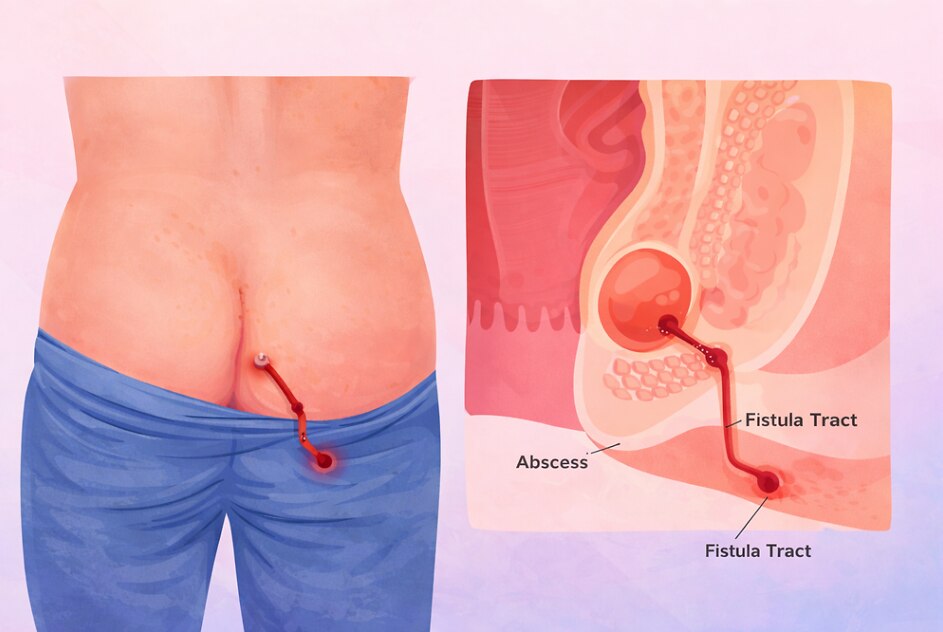
An anal fistula is a persistent tunnel between the anal canal or rectum and nearby skin, usually left after an anorectal abscess. By the end, you will know which symptoms need prompt review, how surgeons map the tract, and how anatomy determines whether laser closure, fistulotomy, seton treatment or another procedure is appropriate.
Key takeaways
- Persistent drainage can indicate a fistula, not a healed abscess.
- MRI pelvis or examination under anaesthesia can map complex fistula tracts.
- The operation depends on sphincter involvement, not only the external opening.
- Laser closure preserves muscle but cannot treat every fistula pattern.
Why an Anal Fistula Keeps Draining After an Abscess
Intermittent pus or blood from a small opening near the anus does not prove that an abscess has healed. An anal fistula is an abnormal tunnel between the anal canal or rectum and nearby skin.
An abscess can form when an anal gland becomes infected; after pus collects and finds a path outward, that cavity may leave a persistent tunnel. The opening can seal briefly, then refill and drain again.
| Acute abscess | Fistula after an abscess |
|---|---|
| Severe, worsening pain, swelling and tenderness | Recurrent swelling or an opening that drains |
| Needs prompt assessment and drainage when pus is trapped | Needs tract assessment and a treatment plan |
| Antibiotics alone do not replace drainage in a drainable abscess | Antibiotics rarely close an established tract permanently |
Arrange medical assessment for recurrent swelling, pus or blood, pain during bowel movements, skin irritation, or fever. A painful abscess needs attention promptly because closing skin can trap infection. A fistula may become obvious after the abscess settles, but not every abscess develops one.
Drainage during healing after surgery can be expected; increasing pain or swelling, fever, heavy bleeding, inability to pass urine, or worsening illness needs urgent contact with the treating service. If drainage persists or returns, request review rather than assuming the disease has resolved.
Multiple openings, repeated fistulas, diarrhoea, abdominal pain or weight loss also warrant assessment for Crohn’s disease.
How the Fistula Tract Is Confirmed and Classified
The surgeon maps three points: the external skin opening, the internal opening inside the anal canal, and any branch or abscess hidden between them. Inspection shows drainage, scars and multiple openings; a digital rectal examination checks tenderness, induration and a palpable internal opening, while anoscopy lets the surgeon inspect the anal canal directly.
Examination under anaesthesia allows a careful, less painful assessment and gentle probing of the tract. It is not a substitute for imaging when anatomy is unclear. Pelvic MRI is particularly useful for recurrent or complex fistulas, suspected abscesses, Crohn’s disease and secondary extensions that inspection can miss.
Endoanal ultrasound can show the tract’s relationship to the sphincter muscles. Both tests complement examination rather than replace it.
Simple and complex disease are separated by anatomy and risk:
| Simple fistula | Complex fistula |
|---|---|
| Low tract involving little external sphincter | High tract involving substantial sphincter |
| Single, direct route with one external opening | Branching tract, multiple openings or horseshoe extension |
| No recurrence and normal continence | Recurrent disease or impaired continence |
| — | Anterior fistula in a woman |
Recurrent fistulas, multiple openings, diarrhoea, abdominal pain or weight loss warrant consideration of gastroenterology assessment for Crohn’s disease. Treating the tunnel alone does not control bowel inflammation; bowel-directed treatment may also be needed.
How Tract Anatomy Determines the Operation
The tract’s route through the anal sphincter determines the operation, not the technology a clinic prefers. A low, simple tract involving little external sphincter muscle is often suitable for fistulotomy, which lays the tunnel open to heal from the base. Cutting a high tract can impair continence.
| Option | What it does | When it fits |
|---|---|---|
| Fistulotomy | Opens the tract along its length | Simple, low fistula with limited sphincter involvement |
| Draining seton | Keeps the tract open and controls sepsis | Active infection, high tract, or staged treatment when immediate cutting threatens continence |
| LIFT | Ties off the tract in the intersphincteric plane | Selected fistulas where preserving sphincter is important |
| Advancement flap | Covers the internal opening with mobilised tissue | Selected high or complex tracts; recurrence remains possible |
Branching or horseshoe disease, a high internal opening, previous operations, Crohn’s disease, and baseline gas or stool leakage shift the balance toward drainage, staged treatment, or a sphincter-preserving repair. Active infection must be controlled before definitive closure. Tell the surgeon about obstetric sphincter injury, diabetes, anticoagulants, and immune-suppressing medicines.
If you searched for anal fistula for surgery central, ask:
- How much external sphincter does this tract cross?
- Is there a branch, horseshoe extension, abscess, or second opening?
- Why is this procedure safer than fistulotomy for my continence?
- Would a loose seton be needed before LIFT or an advancement flap?
- How will recurrence or persistent drainage be checked?
Laparoscopic surgery is not the routine operation for an isolated anal fistula; anatomy, examination and imaging guide the local or transanal approach.
What Laser Closure Involves—and Its Limits
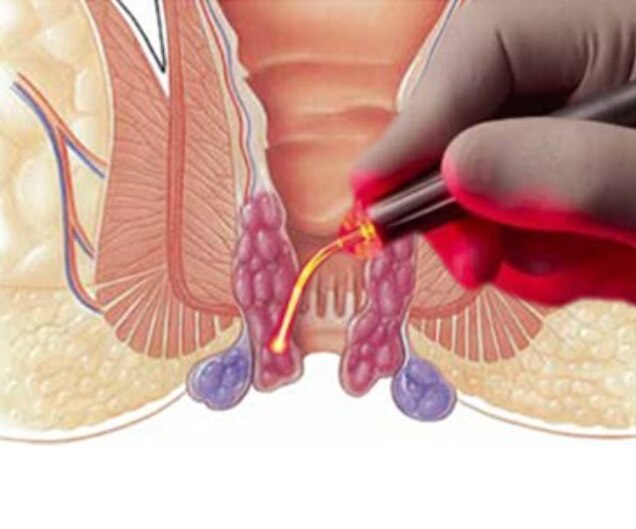
FiLaC, or fistula-tract laser closure, uses a radial laser fibre to treat the tunnel while aiming to preserve anal sphincter tissue. Under anaesthesia, the surgeon identifies the internal and external openings, probes and cleans the tract, then passes the fibre through it.
Controlled energy is delivered as the fibre is withdrawn, heating the tract walls so they collapse and seal. The internal opening is closed separately. The external opening may remain open temporarily to let fluid drain; sealing it immediately can trap infection.
Before choosing laser fistula surgery near Central Mumbai, ask:
- Has the complete tract, internal opening and any branches been mapped?
- Is active infection present, requiring drainage or a loose seton first?
- How much sphincter does the tract cross?
- Do branching disease, a horseshoe extension, previous operations or impaired continence make laser closure unsuitable?
- What is the plan if drainage continues or the fistula returns?
Laser is not automatically safer or curative. Fistulotomy lays open a simple, low tract and can be highly effective, but cutting a high tract or substantial sphincter can affect continence. Laser closure seeks to avoid that division; a persistent tract can still require another operation, seton or different repair. Recurrence remains possible.
Published FiLaC studies are heterogeneous, and long-term comparative evidence is less mature than the established principles of controlling infection, accurately mapping the tract and selecting surgery according to anatomy. Recurrent fistulas, multiple openings, diarrhoea, abdominal pain or weight loss also warrant gastroenterology assessment for Crohn’s disease before local treatment.
How to Choose a Fistula Surgeon near Mumbai Central
Choose a fistula surgeon central to Mumbai on capability, not travel time or a minimally invasive label. Verify training in colorectal or gastrointestinal surgery, experience with anorectal fistulas, access to examination under anaesthesia, pelvic MRI and continence assessment, plus a written follow-up plan.
Ask these questions before consenting:
- Which tract-specific operation fits my anatomy?
- How will you monitor recurrence?
- What will happen if drainage persists or returns?
- Would a draining seton or staged operation protect continence better?
| Option | Main purpose | Question to ask |
|---|---|---|
| Fistulotomy | Opens a simple, low tract | How much sphincter muscle will be divided? |
| Seton or staged surgery | Controls infection before definitive treatment | When will the next stage be assessed? |
| Sphincter-preserving repair | Limits muscle division in selected cases | Why is LIFT or an advancement flap suitable here? |
Tell the surgeon about previous abscess or fistula surgery, gas or stool leakage, obstetric sphincter injury, inflammatory bowel disease, diabetes, anticoagulants and immune-suppressing medicines. These details can change the operation; recurrent fistulas, diarrhoea, abdominal pain or weight loss may also require gastroenterology assessment.
Dr.VinayKumar Thati-Laser & Laparoscopic Surgeon is a local option for discussing anorectal treatment planning, but proximity does not replace tract mapping, continence assessment and a contingency plan.
Contact the treating service promptly for increasing pain or swelling, fever, heavy bleeding, inability to pass urine or worsening illness. Drainage can occur during healing; persistent or returning drainage needs review.
Related service
LASER SURGERY FISTULA laser closure involves introducing the laser fibre into the fistula from the outside and passing it through to the opening inside the rectum. |
Frequently asked questions
Why does an anal fistula keep draining after an abscess?
An abscess can leave an abnormal tunnel between the anal canal or rectum and nearby skin. The tunnel allows intermittent pus or blood to drain through a small opening.
How is an anal fistula tract confirmed and classified?
A surgeon examines the opening and anal canal, then uses tests such as MRI pelvis when the tract is complex or unclear. Classification depends on the tract’s path and its relationship to the anal sphincter muscles.
How does fistula anatomy determine the operation?
A superficial tract may be opened with a fistulotomy. A tract crossing more sphincter muscle requires a muscle-sparing approach, such as a seton, advancement flap, LIFT, or another selected technique.
What does laser fistula closure involve, and what are its limits?
Laser closure uses a fibre placed inside the tract to deliver controlled energy and collapse the tunnel. It is not suitable for every anatomy, and persistent side openings, branches, or recurrent disease can affect results.
How should you choose a fistula surgeon near Mumbai Central?
Ask about the surgeon’s experience with anorectal procedures, how the tract will be mapped, which sphincter-sparing options fit your anatomy, expected follow-up, and the plan if the fistula recurs.
Keywords